
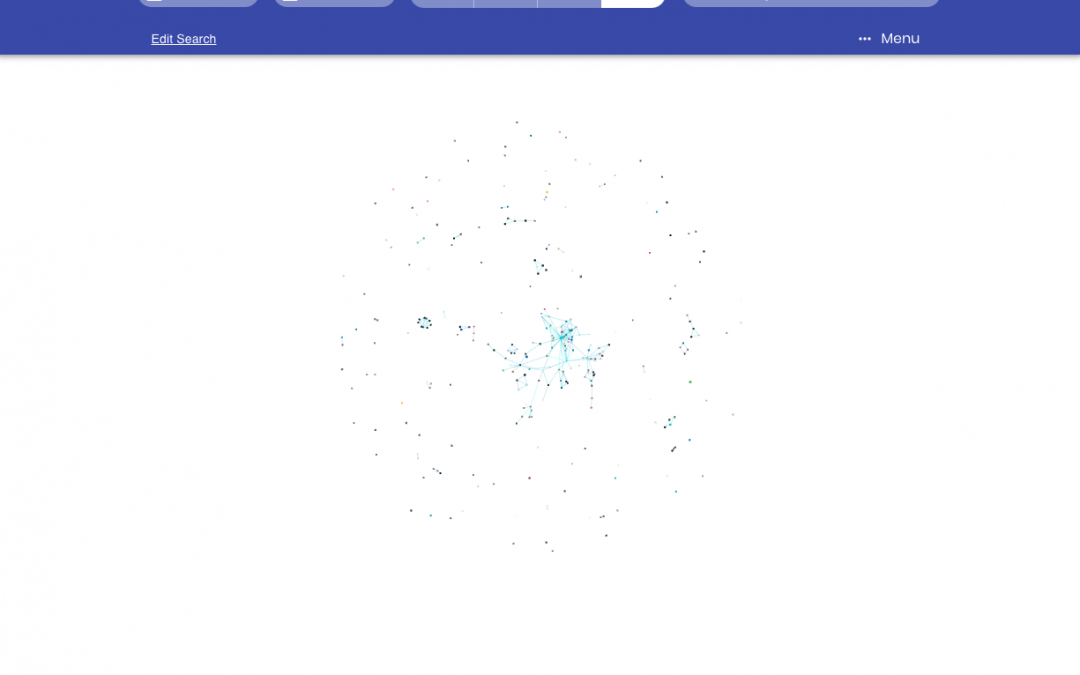
Every country is united in that they are experiencing life in the midst of a pandemic. But, country to country, that experience varies — drastically.
We used Paraqeet to look at the Twitter conversations surrounding the #COVID19 hashtag in four countries that are experiencing COVID-19 at different levels: New Zealand, South Africa, the United Kingdom and the United States.
We filtered our search results to display only verified Twitter users. Given that COVID-19 is a global hot topic, searching the hashtag without filters would result in a mass of information from everyday users. Viewing only verified accounts allowed us to observe how information about COVID-19 was being shared in each country by sources of public interest, so that we could compare the differences in information reaching citizens.
Each country’s #COVID19 network is a reflection of its own lived experience during the pandemic. This experience can be steady (the lucky ones), unpredictable, coordinated, hopeful and more.
Note: The search was conducted from Feb. 2-8 and limited to verified users. Twitter identifies verified users with a blue badge next to their usernames. A verified user is an account of public interest that is authentic. To receive the blue badge, a Twitter account must be authentic, notable and active.
New Zealand’s status: COVID-free
On Feb. 8, New Zealand’s daily new confirmed COVID-19 case count was 2.1 based on a rolling seven-day average. (Yes, you read that right, a single-digit average case count. The island country’s pandemic response undoubtedly has been effective.)
What conversations surrounding COVID-19 are happening in New Zealand? Are there even any conversations around the pandemic?
New Zealand’s network immediately signaled how it is on a different page in COVID-19’s book. Only 16 users carried the conversation surrounding #COVID19.
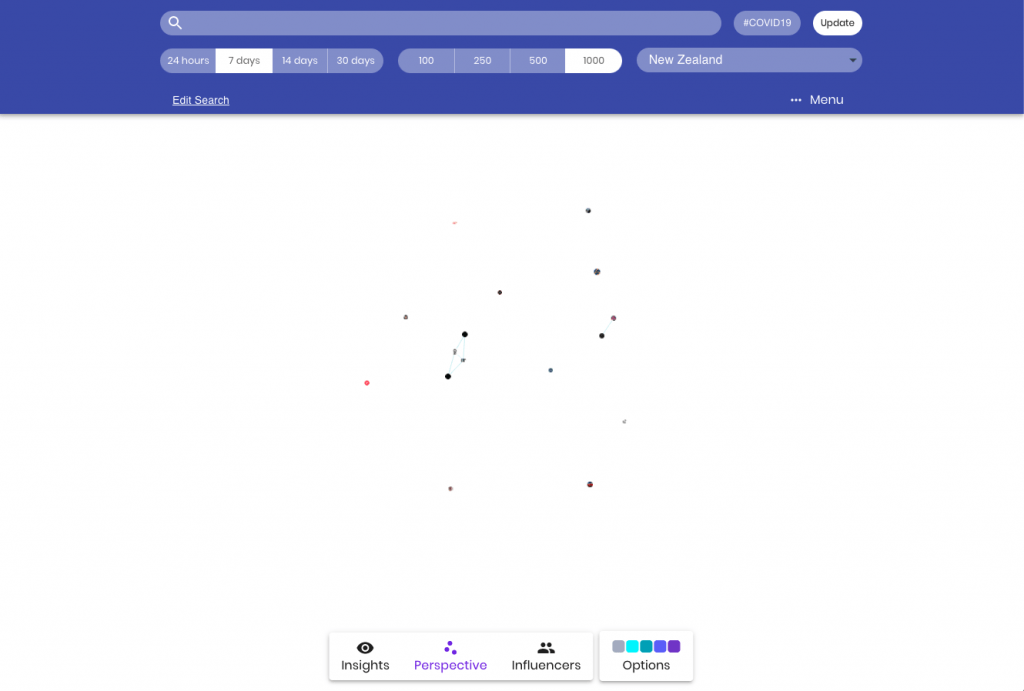
New Zealand’s #COVID19 network
A network this sparse makes sense. A glance at the front page of a New Zealand newspaper shows that it merely touches upon COVID-19. New Zealand has the luxury of time and faring just fine — even if it is at the back of the vaccine queue.
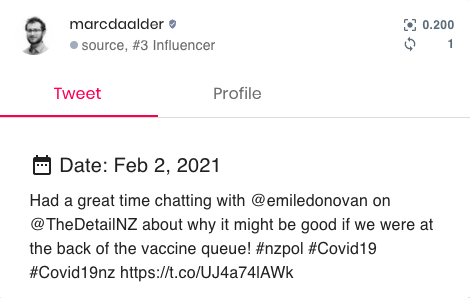
Journalist Marc Alder, No. 3 influencer, sparked a conversation around NZ moving to the back of the vaccine queue.
As other countries are fighting to secure as much vaccine supply as possible, New Zealand has reckoned with its role in fighting off the pandemic.
“It is only right that those countries that are seeing devastating rates of death are receiving those vaccines and have given emergency approval for them to be distributed. New Zealand’s in a very different position, and I think everyone in New Zealand understands that,” Prime Minister Jacinda Ardern said.
New Zealand’s ability to accommodate delayed vaccine distribution is a testament to how different the pandemic has gone there.
It has given one citizen, Dr. Sarb Johal, enough time and space to reflect on the current pandemic to author a book.
-
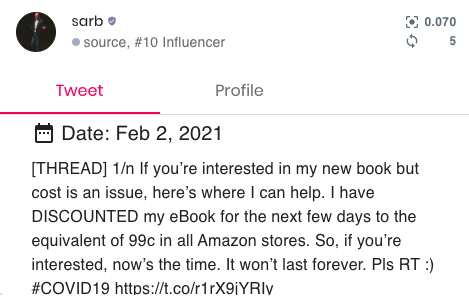
- Dr. Sarb Johal, #10 Influencer, promotes his new book, which is all about staying sane during a pandemic.
-
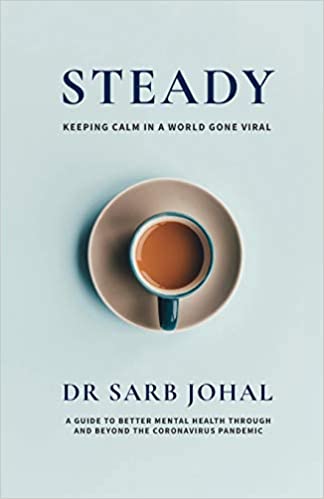
- Dr. Johal’s book, “Steady.”
The book is titled “Steady: A Guide to Better Mental Health Through and Beyond the Coronavirus Pandemic.”
Steady: An accurate description of the state of #COVID19 in New Zealand.
South Africa deals with unpredictability
In December, a more contagious strain of COVID-19 was identified in South Africa. The second spike in South Africa’s daily new confirmed COVID-19 cases shows how this variant (formally known as B.1.351) has amplified the spread.
South Africa’s #COVID19 network demonstrates the unpredictability of this virus. Toward the beginning of the week when this search was conducted, South Africa celebrated the arrival of the AstraZeneca vaccine.
-
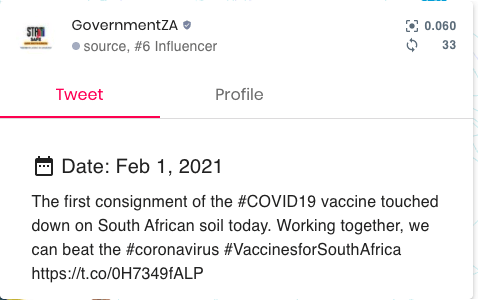
- @GovernmentZA, the No. 6 influencer, celebrated the first arrival of the COVID-19 vaccine.
-
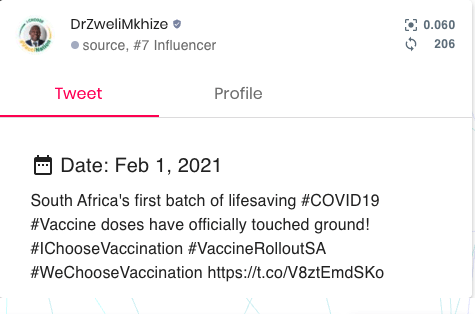
- Dr. Zweli Mkhize, the No. 6 influencer, joined in celebrating this momentous moment for South Africans.
A few days later, evidence emerged that the AstraZeneca vaccine showed no significant reduction in mild to moderate cases of the variant first identified in South Africa. South Africa successively halted distribution of the AstraZeneca vaccine.
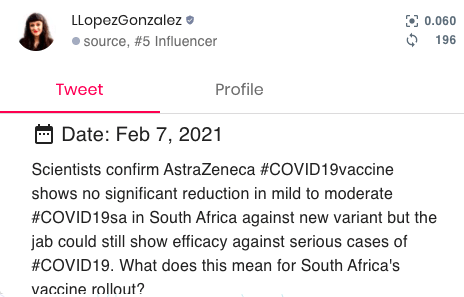
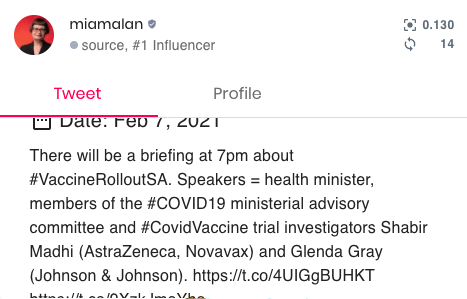
Journalists Mia Malan and Laura Lopez Gonzalez break the news that the AstraZeneca vaccine might not offer as much protection against the variant.
South Africa’s network contained conflicting emotions of hope and concern. Top influencers’ celebration of the vaccine was followed by alarm that it would not help the country fight this new variant.
Citizens grappled with what this meant for the country: What is the vaccine strategy going to be Will this lead to a second pandemic?
-
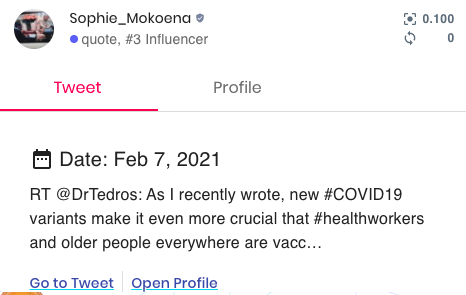
- The No. 3 influencer shares a suggestion to vaccinate healthcare workers and the older population as fast as possible based off of the AstraZeneca findings.
-
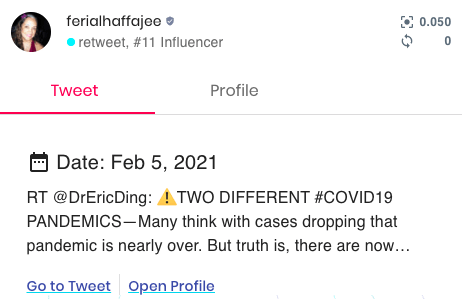
- The No. 11 influencer retweets Dr. Eric Ding who suggests we are living amidst two different pandemics.
It is difficult to control a narrative for something you have little control over. In a pandemic, a message of hope can quickly be followed by one of alarm. Twitter, a place of reactions and emotion, puts this emotional roller coaster on display.
United Kingdom’s united effort
Back to the unpredictability of this virus: The United Kingdom also has been grappling with a more contagious strain of COVID-19, formally known as B.1.1.7.
As in South Africa, the B.1.1.7 variant has caused a massive spike in COVID-19 in the U.K.
The variant prompted the United Kingdom to readjust its COVID-19 response. The government imposed stricter measures, including a countrywide lockdown, and adopted a vaccine distribution strategy that prioritizes administering the first dose to as many people as possible.
In addition, a unified public information campaign factored into the U.K.’s revamped COVID-19 response. And, at the center of the #COVID-19 network is a hub of government-run Twitter accounts spreading relevant information about the virus.

At the center of the U.K.’s network is a central hub of connected government-run accounts.
-
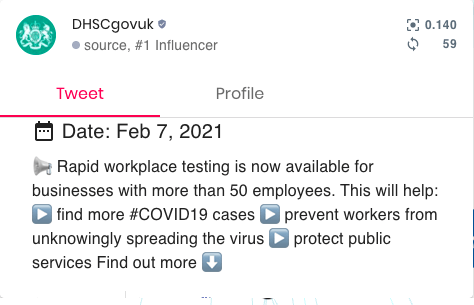
- The Department of Health and Social Care, the No. 1 influencer, shared important information regarding rapid workplace testing.
-
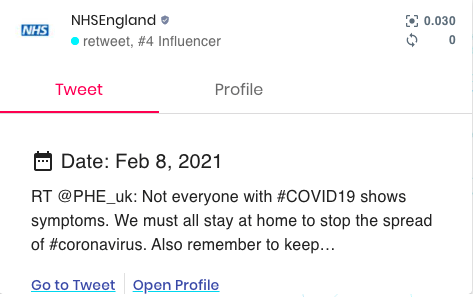
- NHS England, the No. 4 influencer, retweeted another public health account cautioning people to stay at home to stop the spread.
Several of the most influential Twitter accounts are linked to Britain’s National Health Service (the publicly funded health care system), which has pioneered the country’s COVID-19 response.
-
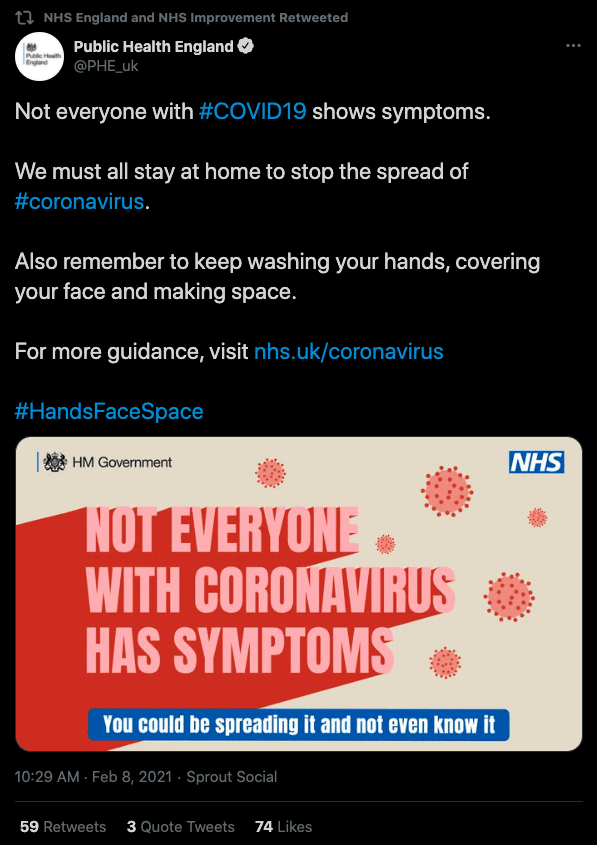
- An example of descriptive and educational graphics featured in many of the tweets sharing information about COVI-19 with the public.
-
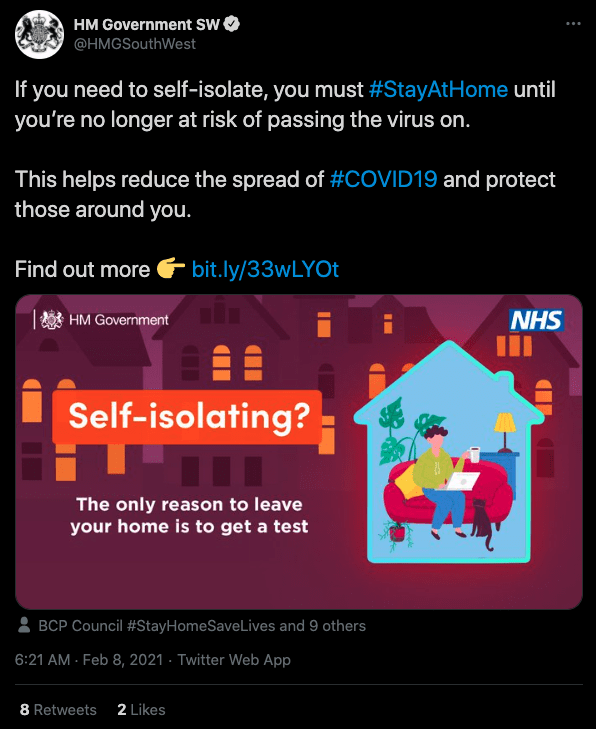
- An example of descriptive and educational graphics featured in many of the tweets sharing information about COVI-19 with the public.
-

- Public Health England tweeted out important COVID-19 updates for U.K. citizens.
The concentrated influence of accounts linked to the government demonstrates how coordination is an effective strategy to get your message heard. This is critical when it comes to a pandemic.
Britain’s information campaign is working in tandem with a massive vaccination effort. According to Bloomberg’s vaccine tracker, the United Kingdom has given 18.9% of its population at least one shot. One military commander who was enlisted by the government to help with the vaccine drive called the undertaking “unparalleled in its scale and complexity.”
The United States (by state)
The United States’ COVID-19 case numbers are steadily decreasing, but the country’s daily, new confirmed cases as of Feb. 8 totaled 110,853.6 — a high number.
Whereas the United Kingdom’s #COVID19 network is coordinated, the United States’ is largely fragmented. Information relevant to different states formed clusters of their own, and this network offered us a glimpse into California, Ohio and Arizona’s top COVID-19 news.
California
California, after experiencing a brutal winter surge, is seeing signs of hope. Gov. Gavin Newsom tweeted a #COVID19 update: California’s case count, positivity rate, hospitalizations and ICU admissions are going down.
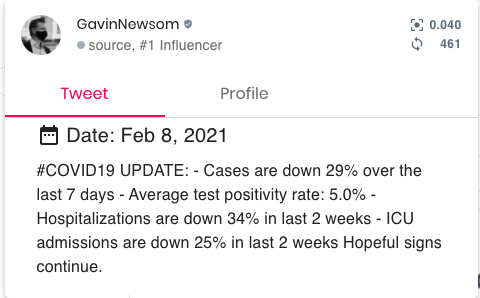
Governor Gavin Newsom, the No. 1 influencer, provided a COVID-19 update for Californians.
Californians celebrated the opening of @PetcoPark — a “COVID-19 Vaccination Super Station.” A tremendous milestone, the vaccination site deservedly received the attention of plenty.
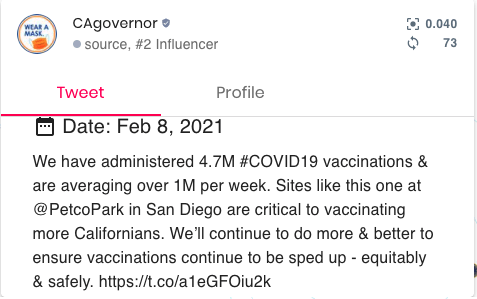
The governor’s official Twitter account, the No. 2 influencer, celebrated the number of vaccines that had been administered at Petco Park.
Ohio
Ohio also celebrated a milestone: The state reported a daily case total of less than 2,000 on Feb. 8, which has not been the case since October.
-
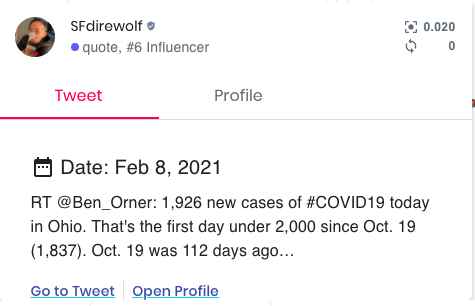
- @SFdirewolf, the No.6 influencer, retweeting a post with Ohio’s case count.
-
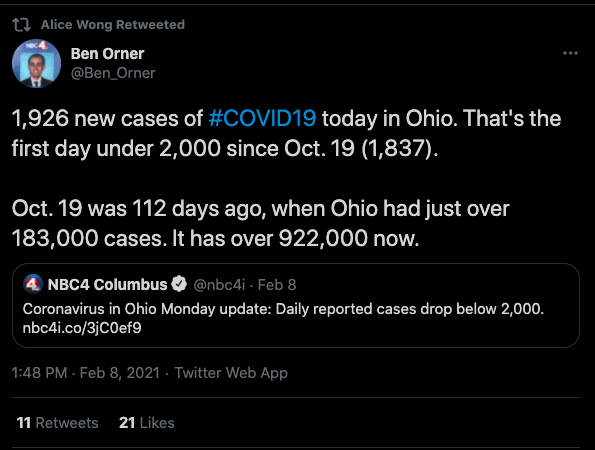
- Ben Orner’s tweet sharing Ohio’s case count.
Although this statistic is jarring, it is a sign of progress nonetheless. It represents just how long and difficult a battle this pandemic has been and continues to be.
Arizona
President Joe Biden and Vice President Kamala Harris visited State Farm Stadium in Glendale, which has been turned into a vaccination site.
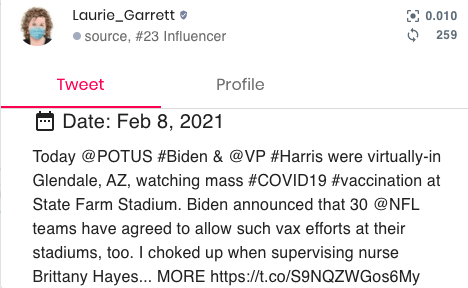
Journalist Laurie Garrett, the No. 23 influencer, reported on President Biden and Vice President Harris’ visit to State Farm Stadium in Arizona.
In California, Ohio and Arizona, tweets that rose to the top in influence maintain a sense of hope. Public figures have turned to positive messaging, and people are looking for signs of progress.
The state-by-state nature of this network is largely emblematic of the United States’ public health governance, which divides the powers among federal, state and local governments.
This structure fostered an information pipeline through which citizens turn to their state or local governments for the latest updates regarding COVID-19. The United States’ #COVID19 network mimics this.
Key Takeaways
Each country (or every state in some cases) has handled and experienced this pandemic differently. The #COVID19 networks in New Zealand, South Africa, the United Kingdom and the United States are a reflection of this. Here is insight gained from the analysis.
- The emotional roller coaster is a lived and online experience
- Effective public information campaigns are coordinated
- Milestones and signs of progress (no matter how big or small) are reasons to celebrate
- Messages of hope triumphed over alarm and concern
- We’re all incredibly jealous of New Zealand
For a behind-the-scenes look at our analysis, check out this post with videos of each country’s network.