

Thanks to the global pandemic, supply, demand and distribution are completely out of whack. We’ve all witnessed this — most famously with last year’s toilet paper shortage. And even as the world is starting to reopen, we keep uncovering more industries that have been gravely affected by COVID-19. That includes the microchip industry.
The unforeseen microchip shortage is especially sobering because of how much our society relies on these tiny silicon wafers. Computer chips are used in countless products — from cars and smartphones to washing machines and video game systems — so, naturally, all of these industries are affected. It’s the textbook definition of supply and demand: Supply is greatly reduced, so prices skyrocket.
Manufacturers are having trouble obtaining supplies of semiconductors, which delays production and delivery and, in turn, drives up prices for consumers. Lockdown living didn’t help, as carmakers cut back on microchip orders, while tech companies snatched up much higher quantities to feed an increased consumer demand for electronics.
That’s exactly the conversation being held on Twitter right now, and Paraqeet helps to make sense of it. We started by using the search terms “microchip” and “shortage.”
Right away, it’s noticeable that this is a rather skewed conversation among verified users.

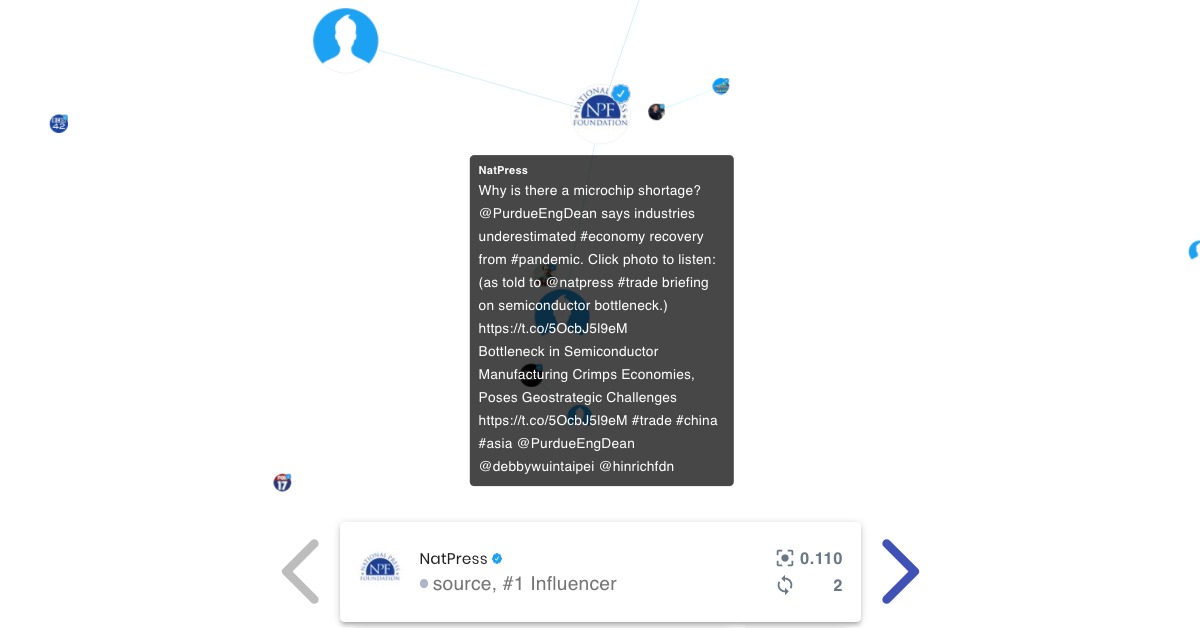
The conversation was dominated by the National Press Foundation, a nonprofit journalism training organization. NPF shared its YouTube video featuring Mung Chiang, dean of Purdue University’s College of Engineering, saying that industries — especially the semiconductor industry — have underestimated what it will take to recover from the economic ravages of the pandemic.
Next, there was MIT Technology Review, a tech publication promoting its piece about how a shortage of microchips could slow future innovation. This was followed by a tweet by Amy Nordrum, a commissioning editor for MIT Technology Review, promoting the same article by Jeremy Hsu.
There was also some interaction between Liz Claman and Keith Krach. Claman, anchor of the Fox Business Network show “The Claman Countdown,” cited how we’re in the eighth month of a severe microchip shortage and was promoting her segment featuring Krach. Krach is a businessman, economist and former diplomat for the Trump administration, and Claman says he’s trying to convince Taiwan Semiconductor Manufacturing Co. to build a chip foundry in Arizona.
Is it a coincidence that Krach was also formerly chairman of the Purdue University board of trustees? Maybe.
Then you had Michigan Rep. Elissa Slotkin, comparing the microchip and car shortages to our shortage of PPE when COVID-19 first hit. She blamed the fact that too many of the products we rely on are made overseas.
Halfway across the country, another conversation took place around The Asbury Park Press’ article about how New Jersey car dealers — and buyers — are reeling from the shortage of semiconductor chips.

When it comes to unverified Twitter users, there are a lot more loose cannons and the conversations are not always well founded. Although there are some of the same points being raised among this group, the sources and sentiments are clearly not as trustworthy.
For example, @DirtyStars believes in the unproven theory that magnets stick to COVID-19 vaccine injection spots and related that to the chip shortage. This person claimed: “The packager of all vaccines, Apiject, put in the microchip, Columbia University made a 1mm chip, the world is currently in a chip shortage, these are all facts, you refuse to even test your arm and you call me crazy.”

Meanwhile, @hereforthealbum is accusing Chevrolet of inflating prices on its vehicles for end users and is “warning” GMC and Ford not to do the same. All this because of a higher-than-typical quote on a Chevrolet Tahoe.
And then there’s @PrimitiveAK, who is a professional gamer for KARNAGE Clan. He mentions it’s a bad time to be looking for a graphics card and blames it on the crypto market but also acknowledges that the microchip shortage is still an issue.
By using Paraqeet’s parameters for verified and unverified users, you can easily filter out the riffraff — and there’s a lot of it out there. Depending on your search topic, you might even want to see what unverified users have to say, as long as you don’t believe everything you read. But it’s your search and your choice: Search by all users, verified only or unverified only.