

Although President Joe Biden has canceled $3 billion worth of student loan debt for a variety of borrowers — including those who were the victims of fraud or school closure and those with a total and permanent disability — this targeted approach has covered only about 0.1% of the $1.7 trillion in outstanding student loan debt, according to Forbes.
We used Paraqeet’s filters to conduct a Twitter search in mid-June of the terms #cancelstudentdebt and #studentdebt, comparing how verified and unverified users were talking about the issue. That can show a snapshot of how effective the communication is between grassroots and grasstop, and who is wielding exactly what influence on an issue.
Not surprisingly, it was a popular topic.

Over several days of searches, Sen. Elizabeth Warren remained the top influencer of verified users, both in her personal account tweets and those made in her official capacity. In asking Biden to cancel student debt, her tweets recalled conversations she’d had with supporters who didn’t think they’d ever be able to repay their entire debt, a story retweeted 2,175 times. Another tweet declared, “You shouldn’t have to get cast in a @shondarhimes TV show to pay off your student loan debt,” as she shared a BuzzFeed story on celebrities speaking out about the issue.
Senate Majority Leader Chuck Schumer netted nearly 2,000 retweets for a simple comment noting today would be a fine day for Biden to take action.
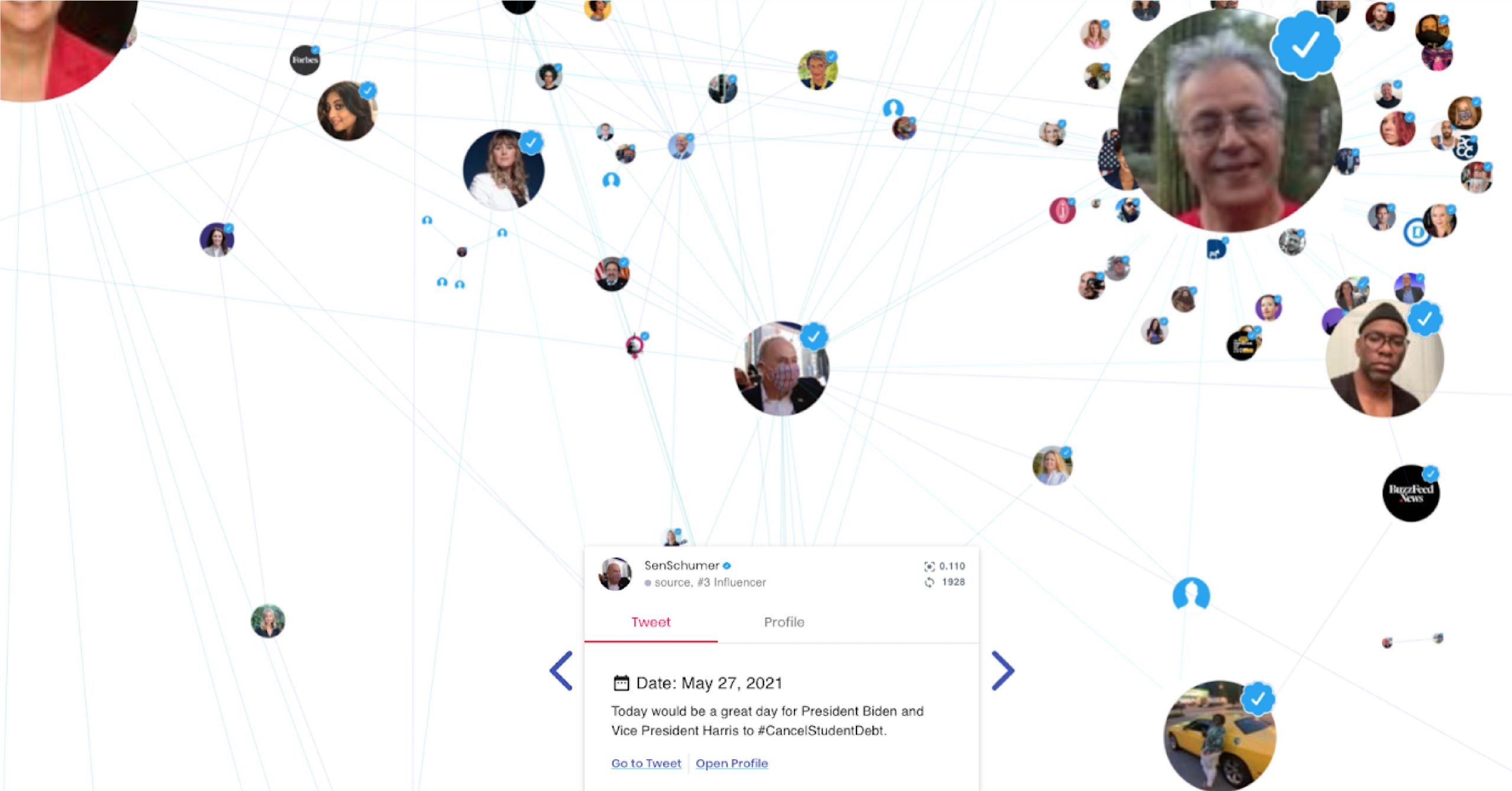
In fact, urging the president to issue an executive order to cancel a portion of the debt was one of the most common sentiments across verified accounts.
Other verified users focused on damages inflicted on different populations and the overall economy.
The Center for Responsible Lending encouraged readers to join a Zoom meeting with Schumer and actress Alyssa Milano to hear the stories of Americans at risk of financial distress who believe student debt has “robbed them of the American Dream.”
Generation Progress noted that Black borrowers have to take on higher debt loads and face greater default rates through race and gender wage gaps and workplace discrimination.
Unverified users most often were calling on Biden to sign an executive order canceling the debt and amplifying posts by Schumer and Warren on the issue. In the first hour after Schumer’s post on how student loan debt is a particularly hard burden on Black borrowers urged Biden to cancel the debt to “help close this racial wealth gap,” 106 unverified users retweeted it. There was also growing popularity of unverified users retweeting — 130 in the first hour — Warren’s concern about what lenders will do to support the millions of borrowers who risk default when student loan payments resume in October.
Other recent tweets by unverified group accounts such as The Debt Collective, described as the nation’s first debtors’ union, complained that in the first week of the pandemic “Wall Street was bailed out to the tune of more than the entire amount of what student debt is.” The group also wrote an executive order for Biden to use to cancel student debt.
Scrolling through unverified users’ comments on verified accounts highlighted a definite opinion divide. For instance, a tweet by U.S. Rep. Alexandria Ocasio-Cortez saying canceling debt is one action Biden can take without Congress generated countless comments from supporters who said the action would improve the economy, enable borrowers to buy houses and address racial wealth inequalities. Opponents complained that they’d already paid their loans or did not attend college to avoid debt, so the move would be patently unfair.
Using Paraqeet’s filtering of verified and unverified users showed supporters of canceling student debt in both categories focused most commonly on the president’s ability to issue an executive order to force the issue. Unverified users were commonly retweeting verified posts to drum up pressure on the president, and verified users, as might be expected, delved more into the overall systemic difficulties debt places on society. The filter feature can help show if the grassroots and grasstop of an issue are speaking the same language and, if not, how to change approaches to make a more effective argument.